6.22.2021

Who Owns Universal Music Group? Here’s the Latest Detailed Breakdown [Digital Music News]


With a valuation greater than $40 billion, UMG is easily the biggest record label and music company in the world. But who exactly who owns Universal Music Group? The answer to that question keeps changing — here’s the latest, most up-to-date breakdown.

Over the weekend, we first reported that special acquisition company (SPAC) Pershing Square Tontine Holdings had officially acquired a 10 percent stake in Universal Music Group. The price of approximately $4 billion pushed the overall valuation of Universal Music Group solidly past $40 billion, with potentially greater valuation growth ahead. So with that deal complete, exactly who ownsUniversal Music Gru

Pershing’s latest deal shifts the mix of who owns Universal Music Group once again, with the company now owned in various percentages by Vivendi SE, Tencent Holdings Ltd, and Pershing Square Tontine Holdings (PSTH). Specifically, Vivendi SE still owns 70% of Universal Music Group, while Tencent Holdings retains 20%, and Pershing Square Tontine Holdings holds 10%.

“After the 20% equity stake acquired by the Consortium led by the Tencent group, the arrival of major American investors provides further evidence of UMG’s global success and attractiveness,” Vivendi confirmed followed the PSTH acquisition.

The biggest change will happen in the fall, when Vivendi spins off shares of Universal Music Group on the Euronext Amsterdam exchange. Specifically, the Euronext public offering (IPO) will involve a 60% selloff, with Vivendi retaining a 10% ownership stake. Vivendi is expected to trigger its UMG offering during the third quarter, with recent estimates suggesting a late-September date.

The IPO would quickly position Tencent as the largest single shareholder, giving the Chinese-owned media conglomerate considerable sway over future corporate decisions.

Incidentally, UMG will be the second major label to go public, behind Warner Music Group, which trades at WMG on Nasdaq. Other music industry have also beat UMG to become publicly traded, including Spotify and Hybe Corporation (previously known as Big Hit Entertainment).

Artists in Universal Music’s deep roster include J Balvin, Taylor Swift, Post Malone, Morgan Wallen, DaBaby, Maroon 5, ABBA, Nas, Mumford & Sons, Lewis Capaldi, Daddy Yankee, Adele, and Andrea Bocelli.

“Universal Music Group is one of the greatest businesses in the world,” Bill Ackman, CEO of PSTH stated following his SPAC buyout. “Led by Sir Lucian Grainge, it has one of the most outstanding management teams that I have ever encountered.”

4.24.2020

Music Industry Blog: Lockdown Listening and the Independent Artist


More great writing from the Music Industry Blog

Lockdown Listening and the Independent Artist


After an initial lockdown lull, streaming levels are – on the surface – beginning to normalise. Underlying the macro-level normalisation, ‘lockdown listening’ is in fact resulting in dramatic shifts in listening behaviour, from using the commute time for activities other than listening to music, through using smart devices to listen at home to spending more time on YouTube. (MIDiA clients can access our latest data on these trends in our latest report COVID-19: Lockdown Listening).
Some of these shifts will have long-term effect while some will last little longer than the lockdown, but now that many artists are losing between 50%-70% of their income with the cessation of live, no artist can afford not to jump on the unique opportunities lockdown listening is throwing up, however fleeting they may be. Moreover with recording studios closed, projects getting put on hold, releases pushed back, not enough music is getting to market when it is needed most. This disruption to music’s supply chain is not going away until lockdown is and independent artists are beginning to look like they could be best placed to respond.
A COVID bounce for independent artists
In 2019 artists direct (i.e. those without record labels) was the fastest growing segment of the total recorded music market, growing by 32.1% in 2019 to reach $873 million, representing 4.1% of the total market, up from just 1.7% in 2015. Momentum was already with independent artists before lockdown, now there is a growing body of evidence that they are prospering in the lockdown listening era too. In Sweden – streaming’s bellwether – indie distribution platform Amuse saw one of its independent artists get 19 of the Top 50 tracks on Spotify’s daily chart in Sweden on March 11th and overall DIY user uploads rose 300% year-on-year for the whole month. Although daily Spotify charts need treating with some caution – especially the Swedish one which seems to routinely throw up disruptive outliers – the underlying trend is clear: independent artists can get a seat at the top table, in fact they can get a lot of the seats. Frequently this then results in majors snapping up artists, such as Lil Nas X and Arizona Nervas.
Release schedule disruption
What is unique about lockdown listening is that we are going to start to see gaps in release schedules. The longer that studio and mastering facilities remain closed, the wider the release schedule gaps will become. Right now, labels still have schedules filled with music that was written, recorded and mastered prior to lockdown. As more lockdown time passes, the more that stockpile will be eaten into. Big label artists have big label sounds. They are teamed up with top-tier writers, session musicians, producers and production facilities. This pre-lockdown advantage becomes a hindrance during lockdown. In contrast, independent artists that are accustomed to doing some or all of their recording and production themselves, lockdown listening is an opportunity to get ahead by releasing music more frequently and consistently than big label artists can. Independent artists platform CD Baby noted it had seen a 30%-50% increase in the amount of music being released since mid-March.
Live streaming to connect with fans
Lockdown may have seemed to have thrown the dynamics of artist careers upside down but in many ways, it is in fact compelling artists to get back to basics of the most important thing: the relationship with their fans. One of the growing failings of the streaming environment has been the demise of places where artists and fans can truly connect. Facebook became a place for labels and managers to sell stuff, Instagram a place for filter-perfect artificiality and streaming just a place for listening. Although there are platforms that nobly break these new rules – Bandcamp especially, fans increasingly relied on live as the place to connect. The immediate cessation of live has seen a surge of live streaming as artists look to maintain that connection. Bandsintown data shows that the number of live streamed shows continues to accelerate, up from less than 400 per day in late-March to more than 2,000 a day by mid-April.
A new artist-fan relationship
With so many live streams and no ‘programming guide’ or meta-schedule, artists have had to double down on social media activity to keep their fans informed. They have also realised – superstar missteps aside – that during these times, fans value seeing their favourite artists without the production values, without the Instagram filters, as people just like them getting through this. This taps into the psychological phenomenon where our brains respond in a particular way when we see someone that we are used to seeing in professional media contexts suddenly looking like someone just like us.
There is a real opportunity here for artists big and small to take these newly redefined relationships into the post-lockdown world. There is a dilemma though: if they don’t, they may face fan backlash, but if they do, they will have to rebuild a new artist persona that trades less on the enigma of star quality than their human qualities. This would mean an entire rewriting of the nature of fame and fandom.
Throughout the history of recorded music, artists have been one step removed, with air of mystique and otherness. The last decade has seen this softened but lockdown may be catalysing a far more dramatic shift. If it does, what we may see may actually be a normalization of fan relationships. Newer, independent artists usually depend on a deeper, loser connection with their fanbases, so many of them already arrived at this point before lockdown. Lockdown is pushing the independent artist rulebook for fan engagement mainstream.

12.22.2019

Another great Music Watch Post | Ten Years After: Music Consumers and the Decade of the Teens

https://www.musicwatchinc.com/blog/ten-years-after-music-consumers-and-the-decade-of-the-teens/


Ten Years After: Music Consumers and the Decade of the Teens


At the close of the “aughts” few in the music industry looked back with nostalgia. The next decade appeared uncertain. Tom Silverman, a label executive, visionary and friend would talk about the billions of consumers around the globe who would soon pay for music. But it was hard to see that happening as we welcomed in 2010.  Turns out Tom was right.
The music industry experienced a rebound in revenues and investment during the past decade.  Both the RIAA (US) and IFPI have reported healthy gains in recorded music revenue over the past three years. This year, 2019, may be the best sales-wise in the US since 2006. The recovery has been an interesting journey; one you won’t think of as you ask Alexa to play your favorite holiday music on your favorite streaming service. But, oh have we changed as music consumers.
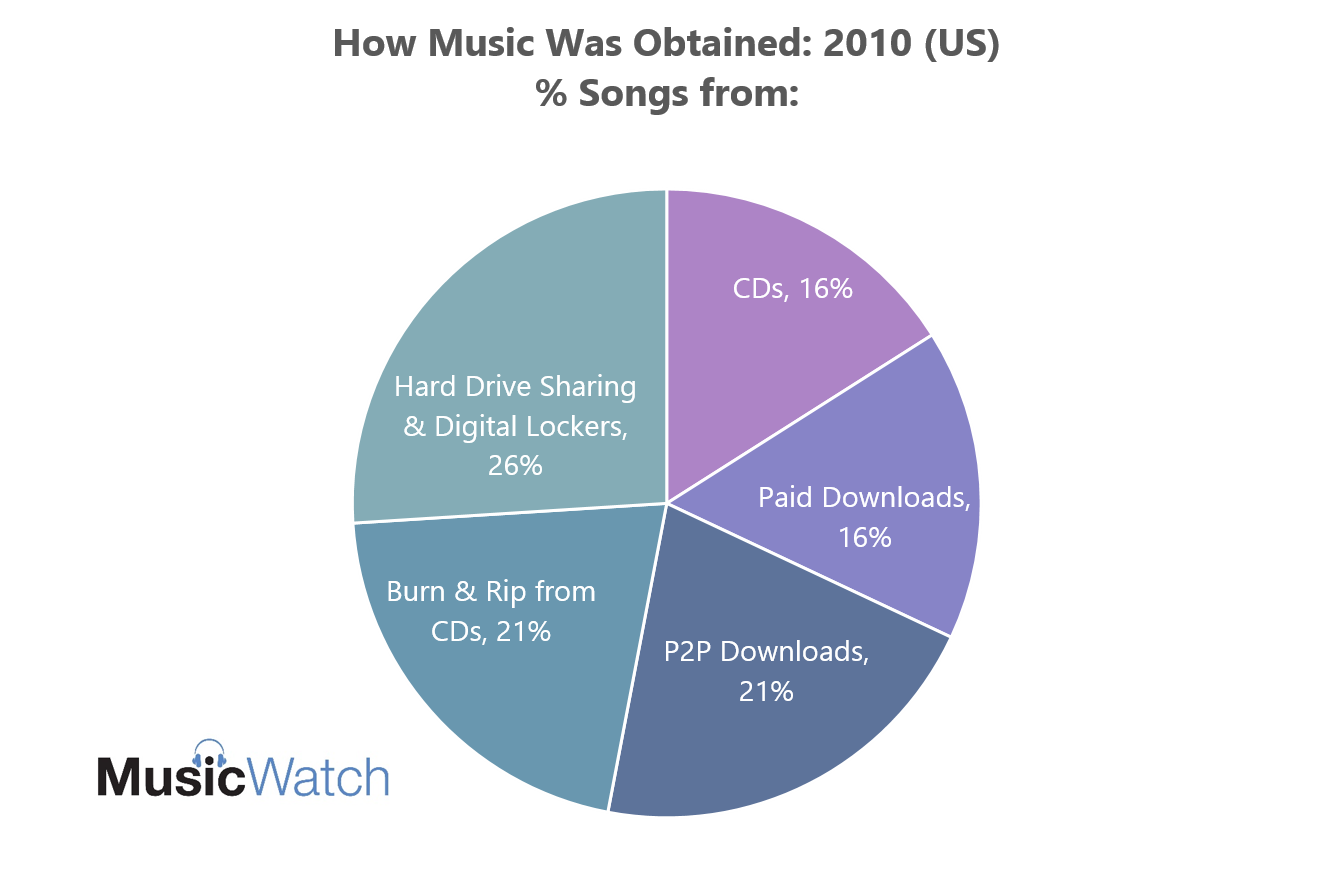
In 2010, 68% of the music we acquired was not paid for. Music piracy has been tempered though not extinguished, as nearly 20M stream-ripped a music file this past year in the US.

By the end of the decade we saw the CD buying population fall by more than half, to 34 million buyers. Ringtones were still popular in 2010, even though smartphones were rapidly replacing our flip-phones.
The most popular device of 2010 was an iPod; 60 percent of internet users used a “touch”, a “mini” or a “shuffle”.  Today, 40 percent are using a smart speaker, as touch has been replaced by talk.
In 2010, 34 percent owned a smartphone; by 2019, 91 percent were using one. Back then Blackberry’s were competing with iPhone’s for market dominance.
Nothing beats the solitude of listening to music in the car. Ten years ago “aux” jacks were rare and we preferred AM/FM radio and CDs, or “Classic Vinyl” on Sirius. Today, 49 percent are using a music streaming service in the car.
Social media hadn’t quite gripped the nation as it does today; imagine, we didn’t even have a Tweeter-In-Chief!  Now, music is one of the key drivers of social media, for discovery, sharing, and increasingly for watching music videos. The number of music fans engaging with music and artists on social platforms has more than doubled – from 29 percent to 62 percent.
Of course, the greatest change in the past ten years has been the shift from ownership to access. Back then we treasured our collections of CDs, and the digital songs on the iPod that we bought, ripped and oh so carefully curated. How our listening habits have changed.
In 2010 only 35 percent of internet users streamed music. Pandora and YouTube were the dominant players.
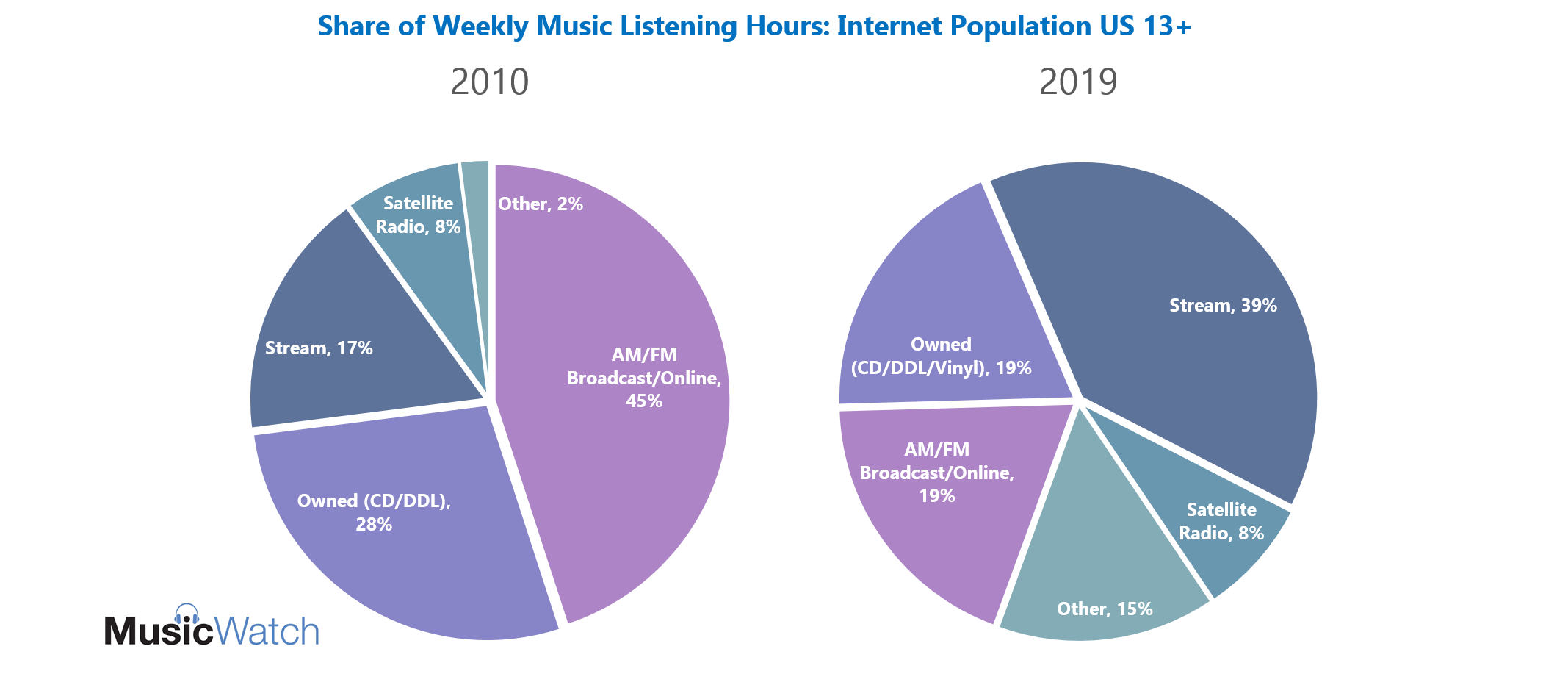
In 2019, 82 percent stream music.  More of us stream today than listen to music on AM/FM radio. In fact, more of us stream than listen to CDs and downloads combined. No surprise the share of how we listen to music has changed so radically:
Though Pandora and YouTube are streaming stalwarts, newcomers such as Spotify, Apple Music and Amazon now account for 36 percent of our streaming listening hours.
In 2010 only 5 million of us paid for a music subscription. In 2Q 2019 we estimated that number had jumped to 68 million. Sirius satellite radio subscriptions grew by 75 percent this decade, on the strength of a portfolio of well curated music stations.
At the beginning of the decade many argued that “music wanted to be free”. This ethos was reflected in falling revenues and troubling consumer acquisition trends. The biggest shift in the past decade has been in the consumer mindset. Thanks to premium access models and ever improving devices, consumers are again paying for music, helping to unlock the music industry’s value.  This benefits the consumers themselves as well as artists, labels, and songwriters.
Pretty much everything about music has changed in the last ten years.  How it gets made, where we find it, how we listen to it.  Even what it means to be a fan.
Everything except the most important thing of all – the music. It’s the music that matters – as it will continue to be ten, fifty, and a hundred years from now.

9.09.2019

Today's NYT-The Album, a Commodity in Disfavor

written by Jeff Leeds. Read the whole thing here.

Some excerpts and commentary...

“If we get two songs out, we get a shot,” said Vatana Shaw, 20, who formed the trio four years ago, Only true fans are buying full albums. Most people don’t really do that anymore.” -- good for country with more loyal and reliable fans

...buyers of digital music are purchasing singles over albums by a margin of 19 to 1.


Because of this shift in listener preferences — a trend reflected everywhere from blogs posting select MP3s to reviews of singles in Rolling Stone — record labels are coming to grips with the loss of the album as their main product and chief moneymaker.

In response, labels are re-examining everything from their marketing practices to their contracts. --
move 10x as fast on these issues as you are now to maybe have a chance

Many music executives dispute the idea that the album will disappear. In particular, they say, fans of jazz, classical, opera and certain rock (bands like Radiohead and Tool) will demand album-length listening experiences for many years to come.-- Agreed, but with whole new business structure and marketing techniques

Executives maintain that they must establish more lasting connections with fans who may well lose interest if forced to wait two years or more before their favorite artist releases new music. --Couldn't agree more, now how are you going to do it?

While music labels labor to build careers for artists that are suited for albums, he added, “You have to create an almost hysterical pace to find hits to sell as digital downloads and ring tones that everybody’s going to want. It’s scary.”
-- You may need a hysterical pace to feed the old business model and structure but that structure is going away. Also, I wouldn't worry about the ringtones as a reliable business. People will (and already do)make their own. Labels should not count on any sustainable income from ringtones.

Vinyl Sales to Overtake CDs for the First Time Since 1986


Sales of vinyl records are likely to overtake CDs for the first time since 1986.

Full article: https://www.digitalmusicnews.com/2019/09/08/vinyl-overtake-cd-sales/

Sept 9, 2019

Last week, we reported on a healthy boom in first-half streaming numbers for the U.S.-based recorded music industry.  But digging deeper into the physical sales story, an interesting figure emerges.
Vinyl record sales have been steadily growing for more than a decade, despite constant predictions of a fad. Now, a mid-year report from the RIAA suggests that CD sales are likely to shrink below vinyl sales in the coming quarters. Earlier this year in February, the RIAA confirmed that vinyl sales account for one-third of the revenue from physical sales.
The RIAA’s 2019 mid-year report was released on Thursday and first reported by Digital Music News. It revealed that vinyl record sales were responsible for generating $224.1 million in sales on 8.6 million units. That’s compared to $247.9 million on 18.6 million CD sales.

Vinyl revenue grew by 12.8% in the second half of 2018 and 12.9% in the first half of 2019.

Meanwhile, revenues from CD sales have barely moved from their 2018 numbers. In total, CDs accounted for roughly 5% of U.S.-based totals, despite some signs of a flattening out.  But the math looks pretty simple here.  Pretty soon, vinyl record sales will surpass revenue from CDs.But what about a CD bounceback? That’s entirely possible. Tellingly, CD unit sales remained flat year-over-year, suggesting a bottoming out of CDs in the U.S. market. But there’s also an unexpected success story from Tool, whose $45 CD album release drew enormous crowds at local record stores last week.  We’re still waiting on the numbers on that recent release.


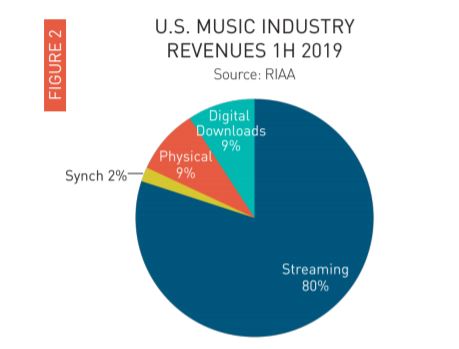
In the U.S. alone, streaming accounted for 80% of the music industry’s revenues in 2019. Physical sales and digital downloads both account for less than 10% each. Digital downloads are falling in the face of music streaming, too.
The vinyl resurgence has helped many artists stay relevant or gain a foothold in the industry. Classic rock groups like Fleetwood MacLed Zeppelin,  Queen all sold over 100,000 albums in 2018. The Beatles top the charts with a whopping 300,000 albums sold in 2018.
Modern artists are embracing the vinyl format by offering limited edition pre-orders for their albums. K-pop album sales are way up thanks to their collectible nature among fans who treat them like trading cards.

8.03.2019

Music Business Worldwide: ‘MASTERS ARE OWNED BY [THE] ARTIST’: CHANCE THE RAPPER MANAGER PAT CORCORAN INKS ‘UNPRECEDENTED’ DEAL WITH WARNER RECORDS FOR 99 NEIGHBORS

Music Business Worldwide

...Calling the deal “unprecedented” and “artist-first”, Corcoran further noted: “The strategy allows Nice Work to step fully into what we love and what we feel we do best; bringing artists and fans closer together via innovative marketing, unparalleled artist-first service and unrelenting determination to protect and promote creators who move us with their music.”

Over on Instagram, however, Corcoran was a little more direct in revealing significant details about the deal.
He wrote: “Masters are owned by artist, creative is owned by artist, profit sharing over royalties, all with the incredible support and platform that our collective teams provide.”
Doesn’t this sound like the sort of ‘label services’ agreement more typically offered by the likes of Sony’s The Orchard, Universal’s Caroline or Warner’s own ADA, not to mention a string of independent players, instead of a major record company deal?

FROM 2007...This Year's Country Sales (so far) And The Changing Business

FROM 2007.....

We are 12 weeks into the "Soundscan Year." In those 12 weeks, the current country chart has sold less than 500,000 units in 10 of those 12 weeks. This is unprecedented. Previously (and correct me if I am wrong) the most weeks under 500k since 1999 was 2.Don't look at this as a dire assessment, or a "glass half empty" scenario, just see it for what it is. A reflection of the changing world. Yes, there has been a light release schedule and the Tim McGraw record released yesterday will help, but to pin this on a light release schedule is hopelessly naive.
Randy Goodman (Lyric Street Pres) has a great take in yesterdays Country Aircheck:
"Regardless of the distribution channels and what they might end up being or looking like over the next decade or so, I'm convinced that there will always be the need for labels (music venture capitalists) to help invest in and grow the next generation of superstars. And I'm equally convinced that the 'deals' that will cement those relationships (artists to labels) are going to fundamentally change."

8.02.2019

MUSIC STREAMING SUBSCRIBERS Spotify Keeps Apple Music at Arm's Length

When Apple launched Apple Music in June 2015, many people thought it would be a question of ‘when’ rather than ‘if’ Apple would catch up with and eventually surpass Spotify. Apple’s financial and marketing power combined with an installed base of hundreds of millions of iOS devices seemed like a tough combination to beat for the Swedish music streaming pioneers.

And yet, ever since Apple launched its own streaming service halfway through 2015, Spotify has managed to keep Apple Music at arm’s length. If anything, Spotify appears to be pulling away from Apple Music in terms of paid subscribers. As the following chart illustrates, the gap between the two streaming services has gradually widened from 20 million when Apple Music was launched to roughly 50 million by June 2019.

As Spotify reported this week, the company that went public in a private listing last year ended the second quarter with 109 million premium subscribers and 232 million monthly active users. In line with its European heritage, Spotify is most popular across the old continent with 40 percent of its premium subscribers located in Europe. North America, the home turf of its fiercest rival Apple Music, is Spotify's second largest market, accounting for 30 percent of premium subs.


7.31.2019

Spotify's paying subscriber base grows to 108m, as total Monthly Active User count hits 232m 
Source: Music Business Worldwide

Spotify closed its second calendar quarter this year with 108m paying subscribers and232m total Monthly Active Users (MAUs).

In a new financial update today (July 31), SPOT confirmed that its premium subs count was up 31% year on year (on the same three months, to end of June, in 2018) – but below the midpoint of its guidance range of 107-110m.

The 108m figure represents a climb of 8m on the 100m subscribers Spotify attracted in the prior quarter of this year.

Worth remembering: Apple revealed last month that Spotify rival Apple Music had recently passed the milestone of 60m paying subscribers, though this figure included free trialists.

Interestingly, Spotify noted to investors today: "We have reached agreement with two of our four major label partners on the renewal of our global sound recording licenses, and are in active discussions with the other two.

"This is the sixth round of label negotiations we’ve worked through in our thirteen year history and, while it is typically a long drawn-out process, it has become part of the normal cadence of the business."

The average paying Spotify subscriber across the world (ARPU) in Q2 2019 paid €4.86, down less than 1% YoY, but down 2% excluding the impact from foreign exchange rates.

"Downward pressure on ARPU continues to moderate, and we continue to expect that ARPU declines through the remainder of the year will be in the low single digits," said Spotify.

SPOT's global Monthly Active User count (232m) was up 29% year-on-year in Q2, and up by 15m people quarter-on-quarter.